Khóa học
IELTS Online
IELTS Online
Giảm đến 18%
Đăng ký ngay
Mục lục [Ẩn]
Listening to the Ocean là một bài đọc thú vị trong đề thi IELTS Reading, khai thác chủ đề khoa học về âm thanh dưới nước và nghiên cứu đại dương. Bài viết này sẽ giúp bạn hiểu sâu nội dung từng đoạn, nắm chắc từ vựng học thuật, và luyện tập các dạng câu hỏi phổ biến như True/False/Not Given. Cùng Langmaster tìm hiểu toàn bộ phân tích, đáp án và mẹo làm bài để bạn tự tin chinh phục kỹ năng Reading nhé!
| Bạn đang ở band IELTS bao nhiêu? Làm bài test miễn phí và nhận ngay lộ trình học cá nhân hóa. 👉 Đăng ký test IELTS miễn phí ngay |
Reading Passage 1
You should spend about 20 minutes on Questions 1-13, which are based on Reading Passage 1 on pages 2 and 3.
Listening to the Ocean
The results of some recent research answer some long-standing questions.
A. The oceans cover more than 70 per cent of the planet's surface, yet until quite recently we knew less about their depths than about the surface of the Moon. The Moon has been far more accessible to study because astronomers have long been able to look at its surface, first with the naked eye and then with the telescope, both instruments that focus light. Until the twentieth century, however, no instruments were available for the study of Earth's oceans: light, which can travel trillions of kilometers through the vast vacuum of space, cannot penetrate very far in seawater.
But it turns out that for penetrating water the best instrument is sound. Curious investigators have long been fascinated by sound and the way it travels in water. As early as 1490, the artist and scientist Leonardo da Vinci observed: "If you cause your ship to stop and place the head of a long tube in the water and place the outer extremity to your ear, you will hear ships at a great distance from you." It was not until 1826 that two scientists, Colladon and Sturm, accurately measured the speed of sound in water. Using a long tube to listen underwater (as da Vinci had suggested), they recorded how fast the sound of a submerged bell traveled across Lake Geneva in Switzerland. What these investigators demonstrated was that water is an excellent medium for sound, transmitting it almost five times faster than its speed in air.
B. A number of factors influence how far sound travels under water and how long it lasts, including particles, salinity, temperature, and pressure. Particles in seawater can reflect, scatter and absorb certain frequencies of sound, just as certain wavelengths of light may be reflected, scattered and absorbed by specific types of particles in the atmosphere. In 1943, Maurice Ewing and JL Worzel conducted an experiment to test the theory that low-frequency waves, which are less vulnerable than higher frequencies to scattering and absorption, should be able to travel great distances, if the sound source is placed correctly. The researchers set off an underwater explosion and learned that it was detected easily by receivers 3,200 kilometers away. In analyzing the results of this test, they discovered a kind of sound pipeline, known as the deep sound channel. Sound introduced into this channel of water could travel thousands of kilometers with minimal loss of signal.
C. The US Navy was quick to appreciate the usefulness of low-frequency sound and the deep sound channel. They developed the Sound Surveillance System (SOSUS), which involved underwater microphones, called hydrophones, that were placed on the ocean bottom and connected by cables to onshore processing centers. It was Christopher Clark of Cornell University who soon realized that SOSUS could be used to listen to whales. Using an SOSUS receiver in the West Indies, he could hear whales that were 1,770 kilometers away.
D. Whales are the biggest of Earth's creatures, yet these animals are also remarkably elusive. Scientists wishing to observe blue whales must simply wait in their ships for the whales to surface. A few whales have been tracked briefly in the wild in this way but not for very great distances, and much about them remains unknown. But by using SOSUS, scientists can track the whales and position them on a map. Moreover, they can track not just one whale at a time, but many creatures simultaneously. They can also learn to distinguish whale calls; researchers have detected changes in the calls of finback whales as the seasons change, and have found that blue whales in different regions of the Pacific Ocean have different calls.
E. SOSUS has also proved instrumental in obtaining information crucial to our understanding of climate. The system has enabled researchers to begin making ocean temperature measurements on a global scale, measurements that are key to understanding the workings of heat transfer between the ocean and the atmosphere. The ocean plays an enormous role in determining air temperature—the heat capacity in only the upper few meters of ocean is thought to be equal to all of the heat in the entire atmosphere. For sound waves traveling horizontally in the ocean, speed is largely a function of temperature. Thus, the travel time of a wave of sound between two points is a sensitive indicator of the average temperature along its path. Transmitting sound in numerous directions through the deep sound channel can give scientists measurements spanning vast areas of the globe. Thousands of sound paths in the ocean can be pieced together into a map of global ocean temperatures, and by repeating measurements along the same paths over time, scientists can track changes in temperature over months or years.
F. Researchers are also using other acoustic techniques to monitor climate. Oceanographer Jeff Nystuen, for example, has explored the use of sound to measure rainfall over the ocean. Monitoring changing global rainfall patterns will contribute to understanding major climate change as well as the weather phenomenon known as El Niño. Since 1985, Nystuen has used hydrophones to listen to rain over the ocean, acoustically measuring not only the rainfall rate but also the rainfall type, ranging from drizzle to thunderstorms. By using the sound of rain underwater as a natural rain gauge, the measurement of rainfall over the oceans will become available to climatologists. In this way, modern society continues to benefit from the investigations of those who, like Leonardo da Vinci, pursued the answers to some basic questions of nature.
Questions 1-4
Do the following statements agree with the information given in Reading Passage 1?
In boxes 1-4 on your answer sheet, write:
TRUE if the statement agrees with the information
FALSE if the statement contradicts the information
NOT GIVEN if there is no information on this
1. In the past, it was easier for scientists to study the Moon than the oceans.
2. Techniques for investigating the Moon are the same as techniques for researching the ocean.
3. Measuring temperature changes in the ocean using sound is more time-consuming than other methods.
4. Hydrophones can distinguish different kinds of rain.
Questions 5-7
Reading Passage 1 has seven paragraphs, A-G.
Which paragraph contains the following information?
Write the correct letter, A-G, in boxes 5-8 on your answer sheet.
NB You may use any letter more than once.
5. Examples of things that affect the distance sound can travel in water.
6. Details of the connection between ocean temperatures and climate.
7. Details of ways in which light and sound are similar.
Questions 8-12
Do the following statements agree with the information given in Reading Passage 1?
In boxes 9-13 on your answer sheet, write:
TRUE if the statement agrees with the information
FALSE if the statement contradicts the information
NOT GIVEN if there is no information on this
8. The US Navy first used SOSUS to monitor marine life.
9. SOSUS has helped scientists learn more about whale communication.
10. SOSUS has only been used to monitor one type of whale at a time.
11. Sound waves traveling in the ocean can be used to track changes in global temperature.
12. The measurement of rainfall using hydrophones has only recently been used in climate studies.
>> Xem thêm:
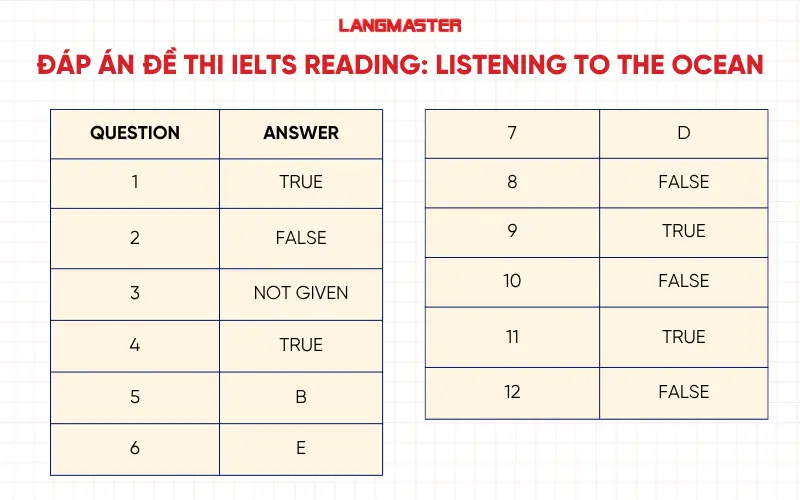
1. Đáp án: TRUE
Câu hỏi: In the past, it was easier for scientists to study the Moon than the oceans. (Trong quá khứ, các nhà khoa học dễ nghiên cứu Mặt Trăng hơn là đại dương.)
Thông tin đoạn A: “The Moon has been far more accessible to study because astronomers have long been able to look at its surface... Until the twentieth century, however, no instruments were available for the study of Earth's oceans.”
=> Đoạn này nói rõ rằng Mặt Trăng dễ nghiên cứu hơn đại dương, vì con người có thể quan sát nó bằng mắt và kính thiên văn, trong khi đại dương thì không có công cụ thích hợp cho đến thế kỷ 20.
2. Đáp án: FALSE
Câu hỏi: Techniques for investigating the Moon are the same as techniques for researching the ocean. (Các kỹ thuật nghiên cứu Mặt Trăng giống như nghiên cứu đại dương.)
Thông tin đoạn A: “The Moon… accessible to study… both instruments that focus light. Until the twentieth century, however, no instruments were available for the study of Earth's oceans: light… cannot penetrate very far in seawater.”
=> Mặt Trăng được nghiên cứu bằng ánh sáng (mắt thường, kính thiên văn), còn đại dương thì không thể dùng ánh sáng vì nước cản trở ánh sáng — nên người ta dùng âm thanh. Hai kỹ thuật hoàn toàn khác nhau.
3. Đáp án: NOT GIVEN
Câu hỏi: Measuring temperature changes in the ocean using sound is more time-consuming than other methods. (Đo sự thay đổi nhiệt độ trong đại dương bằng âm thanh tốn nhiều thời gian hơn các phương pháp khác.)
Thông tin đoạn E: “Transmitting sound… can give scientists measurements spanning vast areas of the globe… by repeating measurements along the same paths over time, scientists can track changes in temperature.”
=> Đoạn này chỉ nói rằng kỹ thuật này giúp đo được nhiệt độ toàn cầu và theo dõi sự thay đổi theo thời gian, nhưng không hề so sánh với các phương pháp khác về việc nhanh hay chậm.
4. Đáp án: TRUE
Câu hỏi: Hydrophones can distinguish different kinds of rain. (Các máy thủy âm có thể phân biệt các loại mưa khác nhau.)
Thông tin đoạn F: “Since 1985, Nystuen has used hydrophones… measuring not only the rainfall rate but also the rainfall type, ranging from drizzle to thunderstorms.”
=> Đoạn này nói rõ rằng máy thủy âm (hydrophones) có thể xác định loại mưa (từ mưa phùn đến giông bão).
5. Đáp án: B
Câu hỏi: Examples of things that affect the distance sound can travel in water. (Ví dụ về những yếu tố ảnh hưởng đến khoảng cách mà âm thanh có thể truyền trong nước.)
Thông tin đoạn B: “A number of factors influence how far sound travels under water and how long it lasts, including particles, salinity, temperature, and pressure.”
=> Đoạn B liệt kê rõ ràng các yếu tố ảnh hưởng đến việc âm thanh truyền trong nước (hạt, độ mặn, nhiệt độ, áp suất).
| Học mãi mà IELTS không lên band? Học thử IELTS miễn phí cùng giáo viên 7.5+, chấm chữa lỗi sai ngay lập tức. 👉 Đăng ký học thử miễn phí ngay |
6. Đáp án: E
Câu hỏi: Details of the connection between ocean temperatures and climate. (Chi tiết về mối liên hệ giữa nhiệt độ đại dương và khí hậu.)
Thông tin đoạn E: “SOSUS has also proved instrumental in obtaining information crucial to our understanding of climate… The ocean plays an enormous role in determining air temperature… For sound waves traveling horizontally in the ocean, speed is largely a function of temperature.”
=> Đoạn E nói rõ: nhiệt độ nước ảnh hưởng đến tốc độ truyền âm, và việc đo nhiệt độ này giúp hiểu mối liên hệ giữa đại dương và khí hậu (chuyển giao nhiệt giữa đại dương và khí quyển).
7. Đáp án: B
Câu hỏi: Details of ways in which light and sound are similar. (Chi tiết về những điểm giống nhau giữa ánh sáng và âm thanh.)
Thông tin đoạn B: “Particles in seawater can reflect, scatter and absorb certain frequencies of sound, just as certain wavelengths of light may be reflected, scattered and absorbed…”
=> Đoạn B so sánh trực tiếp âm thanh trong nước với ánh sáng trong khí quyển, chỉ ra rằng cả hai đều có thể bị phản xạ, tán xạ và hấp thụ.
8. Đáp án: FALSE
Câu hỏi: The US Navy first used SOSUS to monitor marine life. (Hải quân Mỹ ban đầu sử dụng hệ thống SOSUS để theo dõi sinh vật biển.)
Thông tin đoạn C: “The US Navy was quick to appreciate the usefulness of low-frequency sound and the deep sound channel. They developed the Sound Surveillance System (SOSUS)… It was Christopher Clark of Cornell University who soon realized that SOSUS could be used to listen to whales.”
=> SOSUS ban đầu được Hải quân Mỹ phát triển cho mục đích quân sự (giám sát âm thanh dưới biển), sau đó Christopher Clark mới nhận ra có thể dùng nó để nghe tiếng cá voi.
9. Đáp án: TRUE
Câu hỏi: SOSUS has helped scientists learn more about whale communication. (Hệ thống SOSUS đã giúp các nhà khoa học hiểu thêm về giao tiếp của cá voi.)
Thông tin đoạn D: “By using SOSUS, scientists can track the whales and position them on a map… They can also learn to distinguish whale calls; researchers have detected changes in the calls of finback whales… and found that blue whales in different regions have different calls.”
=> Đoạn này cho thấy SOSUS giúp nghe và phân biệt tiếng kêu của cá voi, tức là hiểu thêm về giao tiếp và hành vi âm thanh của chúng.
10. Đáp án: FALSE
Câu hỏi: SOSUS has only been used to monitor one type of whale at a time. (Hệ thống SOSUS chỉ được sử dụng để theo dõi một loài cá voi tại một thời điểm.)
Thông tin đoạn D: “Moreover, they can track not just one whale at a time, but many creatures simultaneously.”
=> Đoạn này nói rõ ràng ngược lại: SOSUS có thể theo dõi nhiều cá thể cùng lúc.
11. Đáp án: TRUE
Câu hỏi: Sound waves traveling in the ocean can be used to track changes in global temperature. (Sóng âm di chuyển trong đại dương có thể được dùng để theo dõi sự thay đổi nhiệt độ toàn cầu.)
Thông tin đoạn E: “The travel time of a wave of sound between two points is a sensitive indicator of the average temperature… Thousands of sound paths… can be pieced together into a map of global ocean temperatures… scientists can track changes in temperature over months or years.”
=> Đoạn E mô tả chính xác việc dùng sóng âm để đo và theo dõi sự thay đổi nhiệt độ đại dương toàn cầu.
12. Đáp án: FALSE
Câu hỏi: The measurement of rainfall using hydrophones has only recently been used in climate studies. (Việc đo lượng mưa bằng thủy âm mới chỉ được áp dụng gần đây trong các nghiên cứu khí hậu.)
Thông tin đoạn F: “Since 1985, Nystuen has used hydrophones to listen to rain over the ocean… Monitoring changing global rainfall patterns will contribute to understanding major climate change.”
=> Đoạn F nói kỹ thuật này đã được sử dụng từ năm 1985, tức là không phải gần đây mới bắt đầu.
>> Xem thêm: Giải đề IELTS Cambridge 16, Test 1: The Future of Work
Trong bài đọc Listening to the Ocean, có rất nhiều từ vựng IELTS Reading liên quan đến âm thanh, đại dương và khí hậu học. Việc hiểu rõ các từ này không chỉ giúp bạn nắm ý chính của bài đọc, mà còn mở rộng vốn từ cho phần Writing và Speaking. Dưới đây là danh sách những từ và cụm từ vựng quan trọng thí sinh cần lưu ý:
Nếu bạn muốn nâng cao vốn từ vựng học thuật và rèn kỹ năng đọc – hiểu sâu bài IELTS Reading như Listening to the Ocean, thì khóa học IELTS Online của Langmaster chính là lựa chọn lý tưởng.

Tại Langmaster học viên được:
Đăng ký học thử IELTS Online miễn phí ngay hôm nay để trải nghiệm lớp học thực tế, kiểm tra trình độ và nhận lộ trình học tập hiệu quả, giúp bạn thành thạo kỹ năng IELTS Writing và chinh phục mục tiêu IELTS!
Khi ôn luyện đề IELTS Reading “Listening to the Ocean”, học viên không chỉ nắm vững đáp án đúng mà còn phát triển khả năng phân tích theo từng dạng câu hỏi một cách logic. Đây là nền tảng quan trọng giúp thí sinh nâng cao kỹ năng đọc hiểu, từng bước đạt mục tiêu band điểm cao trong phần IELTS Reading, tạo lợi thế vững chắc trong toàn bộ kỳ thi.





Các dạng bài phổ biến và tiêu chí chấm điểm IELTS Reading chi tiết nhất: Multiple Choice, Matching Information, Matching Headings,... và hướng dẫn chiến lược làm bài hiệu quả

Những sai lầm khi luyện IELTS Reading bao gồm: dịch từng từ, đọc hết cả bài, không đọc câu hỏi trước, không quản lý thời gian, không nắm vững kỹ năng paraphrase, viết sai chính tả
![Giải đề IELTS Reading: A brief history of humans and food [full answers]](https://langmaster.edu.vn/storage/images/2025/09/20/a-brief-history-of-humans-and-food-ielts-reading-answers.webp)
Giải đề thi IELTS Reading “A brief history of humans and food” kèm full đề thi thật, câu hỏi, đáp án, giải thích chi tiết, và từ vựng cần lưu ý khi làm bài.

Tổng hợp IELTS Reading tips hay nhất giúp bạn đọc nhanh, nắm ý chính và xử lý thông tin chính xác, tự tin đạt điểm cao trong kỳ thi IELTS.
![Giải đề IELTS Reading: The importance of law [Full answers]](https://langmaster.edu.vn/storage/images/2025/09/22/55.webp)
Giải đề IELTS Reading “The importance of law” kèm đáp án chi tiết, từ vựng quan trọng và bí quyết luyện thi hiệu quả để nâng cao band điểm.





Hơn 16 năm kinh nghiệm, đào tạo thành công 800.000+ học viên
Phương pháp giảng dạy hiện đại, học viên tiến bộ rõ rệt
Lộ trình học chuẩn quốc tế, phù hợp với nhu cầu thực tiễn
Giáo viên đạt chuẩn Quốc tế với chất lượng top đầu thị trường, giàu kinh nghiệm
Học online linh hoạt, cam kết đầu ra bằng văn bản



![Giải đề IELTS Reading: Neuroaesthetics [Full answers]](https://langmaster.edu.vn/storage/uploads/original/2025/10/11/giai-de-ielts-reading-neuroaesthetics.png)
![Giải đề IELTS Reading: Classical music over the centuries [Full answers]](https://langmaster.edu.vn/storage/uploads/original/2025/10/11/classical-music-over-the-centuries-answers.png)